Key takeaways:
- Sales don’t equal cash. Delays in credit, inventory, and payments affect the real cash flow.
- Billing software improves cash flow by speeding collections, reducing leakage, and giving real-time visibility.
- Gofrugal gives you complete cash control such as manage credit, track stock, and monitor real-time cash flow without confusion or manual effort.
Ask yourself one simple question:
If your biggest supplier asked for full payment today, could you confidently say yes without checking multiple registers? If you hesitate, the problem isn’t sales. It’s cash visibility. Many retailers record strong daily sales. Bills are printed, customers are paying, shelves are moving. On paper, everything looks healthy. But when it’s time to make a payment, uncertainty creeps in.
- How much cash is actually available right now?
- How much is stuck in customer credit?
- How much is pending in digital settlements?
- Is the stock on the shelf converting into real money fast enough?
This gap between recorded sales and available cash is where retail cash-flow problems begin and it clearly shows why a structured billing software is no longer optional, but essential.
Why cash flow is a major challenge in retail today
Cash flow is a major challenge in retail because sales are recorded instantly, but actual cash often moves slowly due to delays, blocked inventory, credit, and limited visibility. Here are the five real reasons behind this.
- Sales happen, but cash comes later: Revenue is recorded immediately, but credit terms and digital payment settlement cycles delay when the money actually becomes available for use.
- Money gets stuck in inventory: Every unsold or slow-moving product on your shelf represents money already spent, reducing the liquid cash available for daily operations.
- Credit sales slow down real collections: When customer dues accumulate without strict tracking and timely follow-ups, sales look healthy while actual collections slow down.
- Digital payment settlement delays: Although customers complete payments instantly through UPI or cards, settlement timelines and reconciliation delays can affect real-time cash availability.
- Lack of real-time visibility increases stress: When retailers cannot clearly see daily collections, outstanding dues, and stock movement during business hours, financial issues are often noticed only after cash pressure builds.
Cash flow vs. Profit in retail: Why this difference matters
Many retailers think, “My store is making profit, so I’m safe.” But in retail, profit and cash are not the same. You can show profit in your books and still struggle to pay your supplier because you don't have available cash on hand. Here’s the simple difference:
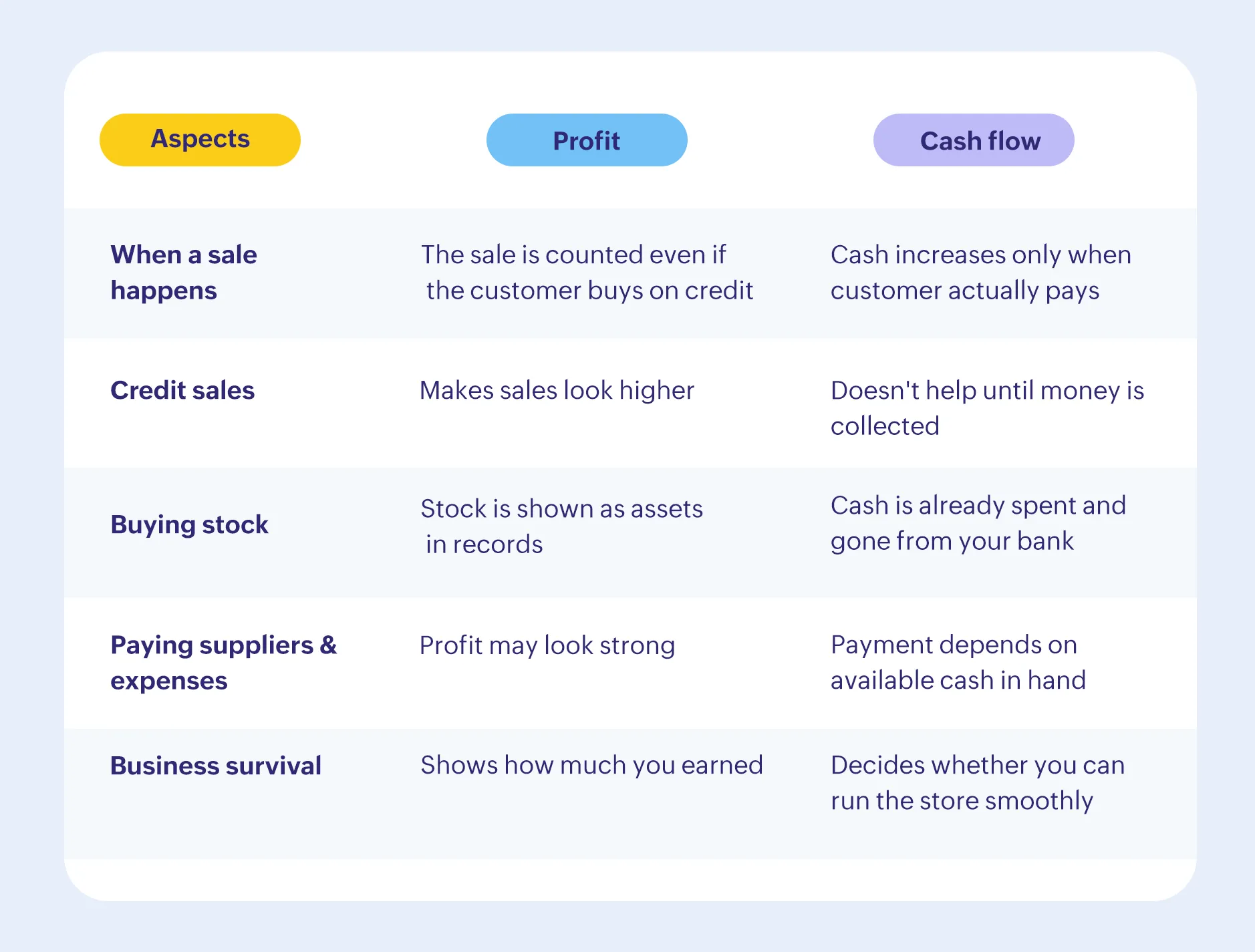
If money is stuck in credit or inventory, profit won’t help you. You need real cash in the bank. That’s why managing cash flow is more important than just increasing sales. That’s where a proper billing system becomes essential. It helps you turn sales into real, usable cash faster.
How manual billing affects cash flow in retail
You’re about to pay your supplier. Sales were strong this month. But when you check your numbers, you’re unsure how much is stuck in credit, how much is pending in digital settlements, and whether collections were fully recorded.
That hesitation usually starts with manual billing and this isn’t uncommon. According to recent data, around 60% of small businesses struggle with cash flow management, highlighting how widespread cash visibility problems are in daily operations.
- Dependence on people instead of process: When billing relies on manual entries and staff memory, small errors and unrecorded discounts quietly reduce actual collections, weakening the cash available when payments are due.
- No structured record for financial review: Without organized tracking of credit, payment modes, and daily totals, you cannot instantly see your true receivables and liquidity position during critical payment decisions.
- Delayed decision-making: When financial data is reviewed late, rising credit and blocked inventory go unnoticed until they create real cash pressure.
- Unclear tracking of money movement: If cash, card, UPI, and credit are not automatically reconciled, your available funds become estimates rather than confirmed numbers.
- Reduced control as the business grows: As sales volume increases, manual systems create more inconsistencies, making cash flow harder to predict and manage confidently.
So the real question becomes how do you fix this structurally.
How can retailers improve cash-flow management with billing software
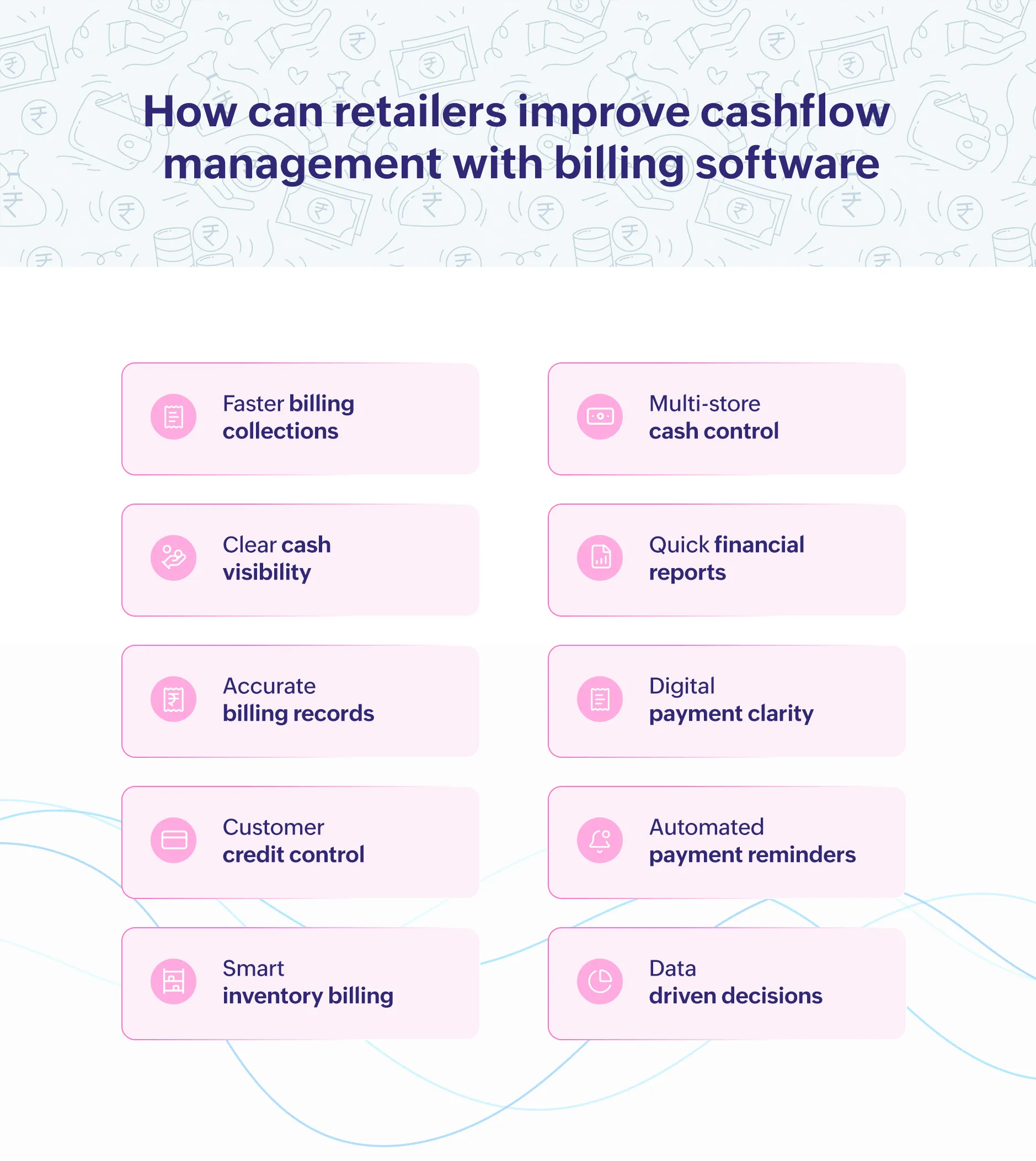
Billing software improves cash flow by helping retailers collect money faster, reduce revenue leakage, control credit, and make better decisions using real-time visibility.
Cash flow doesn’t improve because sales increase. It improves when money moves faster and stays under control. That shift often begins at the billing counter. According to a U.S. Bank study, reported by Forbes, 82% of business failures are linked to poor cash-flow management, not lack of sales.
Faster billing turns sales into immediate cash
Every completed bill is potential cash in hand. But when billing is slow or manual, mistakes happen, queues grow, and sometimes sales are lost. A retail billing software speeds up checkout, calculates tax correctly, and supports cash, card, and UPI payments without confusion. More importantly, it ensures every sale is recorded properly. Even small billing delays show up later as tight cash positions.
Real-time visibility removes cash visibility
Many retailers sell well all month yet hesitate before making payments because they are not fully sure of their real cash position.
Billing software gives real-time sales tracking. You can see:
- Today’s total sales
- Payment mode split
- Outstanding credit
- Actual collections
When you clearly know how much cash is available, you can plan supplier payments better and avoid sudden shortfalls. Clarity itself improves retail cash-flow management.
Accurate billing protects your working capital
Small billing mistakes reduce margins quietly. Wrong pricing, missed items, uncontrolled discounts, or tax errors may seem minor, but over time they reduce the cash you actually retain. Automated billing protects every rupee earned. You don’t need more customers to improve cash flow, you just need to stop losing the money you already made.
Structured credit control improves collections
Credit is common in retail business. The problem is when credit is not tracked properly. Without clear credit management:
- Dues increase silently.
- Limits are crossed.
- Follow-ups get delayed.
Billing software tracks who owes you, how much, and for how long. It supports structured reminders and credit limits.
You don’t have to make uncomfortable calls. The system keeps receivables disciplined, and your money comes back faster. That improves liquidity without affecting relationships.
Inventory-linked billing prevents cash flow from dead stocks
Inventory is money already spent. When purchases are made without looking at real sales trends, slow-moving stock blocks cash. Shelves stay full, but bank balances stay tight. Billing software connects sales data with inventory management. You see what sells fast, what doesn’t, and what should not be reordered.
When you stop buying what doesn’t move, cash stops sitting on shelves and stays available for business needs. That improves retail working capital naturally.
Centralized multi-store cash monitoring improves financial control
Managing cash flow across multiple outlets is difficult when you depend on manual reports or staff updates. Delays and mismatches often go unnoticed.
Billing software centralizes sales, collections, and payment data from all branches in one dashboard. You can compare performance, detect cash mismatches early, and maintain stronger financial control across locations. Clear visibility across stores directly supports better retail cash-flow management.
Faster financial reporting enables timely decisions
Cash gaps often happen because decisions are delayed. With real-time reports in billing or POS software, you can check daily sales, payment splits, and product performance instantly. This helps you plan supplier payments, adjust purchases, and run promotions at the right time. When decisions are made early, working capital stays stable and cash flow improves.
Digital payment tracking improves cash clarity
Digital payments are now a major part of retail sales. But without proper tracking, settlement delays create confusion between reported sales and the actual bank balance. Integrating advanced billing software like Gofrugal tracks digital collections clearly and simplifies reconciliation. You know what is received, what is pending, and what needs action. Clear reconciliation strengthens day-to-day cash control.
Automated payment reminders improve receivables
Customer dues often increase because follow-ups are inconsistent. Billing software sends automated payment reminders, reducing awkward conversations and improving payment discipline. Overdue amounts reduce gradually, and receivables remain under control. Systematic collections strengthen liquidity and support steady retail cash flow.
Better reporting helps you plan with confidence
Cash flow problems often come from delayed decisions. With instant financial reports, you can:
- Identify profitable products.
- Adjust stock purchases.
- Plan supplier payments.
- Prepare for seasonal changes.
Instead of asking, “Will I manage this month?” you can start planning the next month confidently.
How Gofrugal improves cash flow for retailers
Cash flow pressure in retail usually comes from delayed collections, unclear numbers, unmanaged credit, and money tied up in stock. Gofrugal improves retail cash flow by accelerating collections, providing real-time cash visibility, controlling credit, preventing billing leakage, and optimizing inventory investment.
- Speeds up billing and daily collections: Billing software ensures quick, accurate checkouts with automated pricing, tax calculation, and digital payment integration. Every sale is recorded correctly and converted into collected revenue without delay.
- Real-time cash visibility: Live dashboards show daily sales, payment mode split, and outstanding dues instantly. Retailers know their exact cash position and can plan supplier payments confidently.
- Controls credit sales and outstanding dues: Customer credit, dues, and payment history are tracked systematically. Structured reminders and limits keep receivables under control and improve collection cycles.
- Reduces cash leakage and billing errors: Automated billing eliminates pricing errors, missed items, and uncontrolled discounts. Protecting margins directly strengthens working capital.
- Improves inventory movement: Billing data connects with inventory management, helping retailers stock based on real demand. Reduced overstocking improves stock rotation and frees blocked cash.
Retail is about rotation. Money goes to suppliers. Products move to shelves, sales happen, and cash must be returned quickly. When that rotation slows, cash pressure builds. Billing software keeps money moving by speeding up collections, controlling credit, and providing clear visibility over sales and inventory. If cash flow uncertainty feels normal in your store, it’s time to upgrade the system behind your billing. Solutions like Gofrugal help retailers like you turn daily sales into predictable, usable cash. Because in retail, success isn’t just about selling more, it’s about keeping money moving.